

Each year, millions of high school students earn college credits, yet too many of them arrive at community colleges or four-year institutions unaware of the credits they have, how those credits apply to a degree, or what opportunities those courses can lead to.
Dual enrollment (DE) is at an inflection point today. State legislatures are expanding transfer guarantees. Community colleges are investing in high school partnerships. And students, particularly first-generation students and those from historically underserved communities, are looking to DE as a path to college access that is both affordable and meaningful.
For Ivy Tech Community College, the question was not whether artificial intelligence could support dual enrollment goals, but how it could be introduced responsibly. Early, career-connected exploration and integrated pathways were intentionally positioned not as recruitment mechanisms, but as foundational elements of long-term student success.
Emery Peck, Chief Operating Officer at Ivy Tech Community College, Muncie Campus, shares, "The opportunity extends beyond using AI to answer student questions. The broader value is its ability to help organize the space between a student's early interests, program selection, advising, and career exploration. These are often treated as separate moments, even though students experience them as one continuous journey. When the connections are unclear, students can lose momentum or struggle to understand how one decision leads to the next."
 Dual Enrollment Overview
Dual enrollment, sometimes called concurrent enrollment or college in the high school, has become a central strategy for expanding college access. Traditionally anchored at community colleges, which often draw half or more of their enrollment from high school partnerships, these programs offer students a head start: real college credits, earned at reduced or no cost. Increasingly, four-year institutions are also entering the space, signaling a broader shift.
The research is clear on what well-designed DE programs can accomplish: Students who participate in DE are more likely to enroll in college after high school, persist through their first year, and complete a meaningful credential.
The same research that documents DE's potential also reveals a challenging pattern: The program design, the advising infrastructure, and the communication systems surrounding dual enrollment frequently fall short of what students need and what teams require to support them at scale.
Fragmentation Across Institutions and Policies
Dual enrollment operates within a complex, layered policy environment. State laws govern which credits transfer and how. District agreements determine which courses are available. And individual high schools, sometimes even individual counselors, decide whether to promote the program at all. In some states, a district's enthusiasm for DE does not translate to high school support, because each school retains discretion over scheduling, advising priorities, and how DE is communicated to families. Students in the same county can have dramatically different access to dual enrollment based on which high school they attend.
Complex Advising Infrastructure
Community college advisors managing dual enrollment populations face a unique challenge: their students are simultaneously enrolled in a high school and a college, navigating two systems, two calendars, and two sets of expectations. Traditional advising models, built for full-time, on-campus students, are poorly equipped for this level of support. The challenge is not only answering individual questions. It is maintaining continuity as students move from interest to course selection, from earned credit to program choice, and from academic planning to career exploration across multiple institutional partners.
Counselor and Parent Communications
Even when DE programs are well-structured and credits are guaranteed to transfer, institutional resistance can undermine student participation. High school counselors, often stretched thin and unfamiliar with community college pathways, sometimes discourage dual enrollment, perpetuating the myth that community college credits carry less weight. Parents absorb the same message and steer students away from programs that would genuinely serve them.
What Students Need Most: Research Behind Building Intentional Pathways
|
What Students Need |
What that Means in Practice |
|
Earlier Awareness |
Students want to learn about DE options before 11th or 12th grade — ideally as early as 8th or 9th grade when course planning begins. |
|
Informed Advisors |
Students want advisors who understand both the high school and college sides of DE and can answer questions about transfer, credit, and academic fit. |
|
Career Alignment |
Students want their DE courses to connect to actual fields of interest. |
|
Engaging Courses |
For students in virtual courses, quality and instructor connection matter. |
|
Life Balance Guidance |
Managing a social life, extracurriculars, and college coursework simultaneously is genuinely difficult. Students want help navigating it. |
|
Financial Guidance |
Students want to understand the financial implications of their DE participation and how it sets them up for what comes next. |
Source: https://ccrc.tc.columbia.edu/research/high-school-to-college.html
Transforming Dual Enrollment Student Engagement in Four Steps
Since 2025, Ivy Tech Community College Muncie Campus and Advisor AI have partnered to explore responsible AI applications for dual enrollment, uncovering practical insights on transforming student success initiatives.
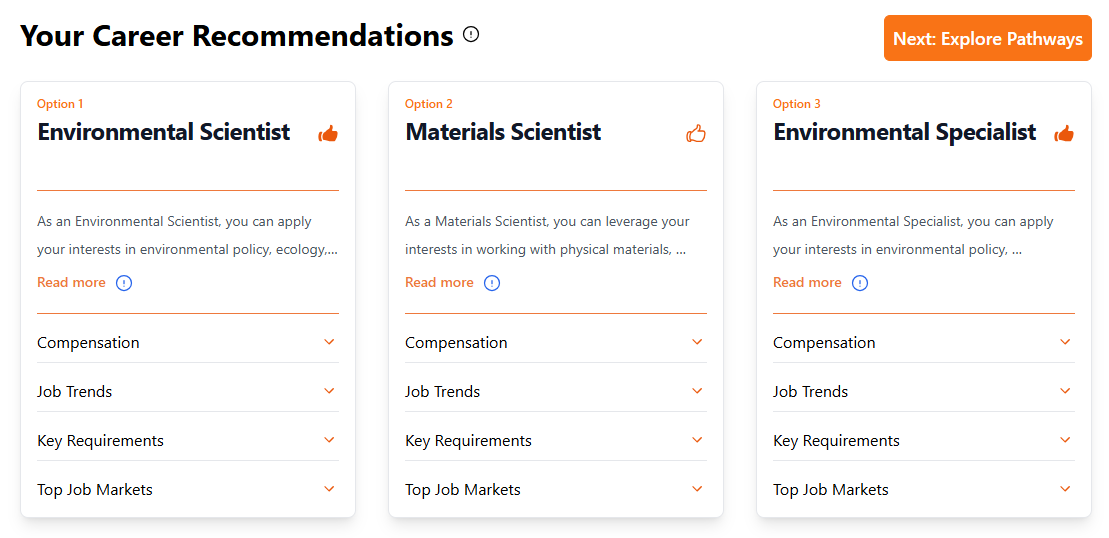
1. Early Career Exploration: Connecting Courses to Real Futures
One of students' clearest stated needs is career alignment. They want their coursework to connect to something real. Advisor AI’s Pathways platform at Ivy Tech Muncie helps a dual enrollment student connect early interests to possible programs and careers, understand how current courses and earned credits fit within those pathways, and identify meaningful next steps after high school. Rather than treating career exploration as a separate activity, the platform helps advising teams place it within the student’s broader academic and career journey.
Criteria met: Career Alignment, Earlier Awareness, Engaging Courses
2. Personalized Pathways: Navigating the Path with Clarity of Next Steps
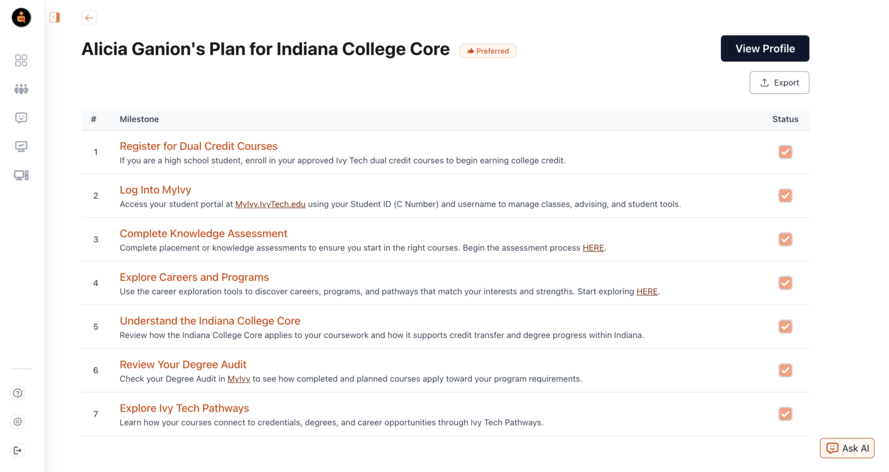
College planning is a sequence of connected decisions: which credits to take, how they apply to an intended program, when to complete required milestones, what documentation is needed, and how each decision supports longer-term academic and career goals. Through clear, milestone-driven pathways and conversational assistance, the Ivy Tech Muncie dual enrollment and advising team is providing students with a more coherent roadmap while augmenting the advisors' role in interpreting options and helping students make informed choices.
Criteria met: Earlier Awareness, Life Balance Guidance, Financial Guidance
"The platform supports a more connected advising model by surfacing information earlier, giving staff a clearer picture of student momentum, and creating stronger handoffs among high school partners, dual enrollment advisors, and career services. The technology provides structure, while human relationships, professional judgment, and institutional responsibility remain central." — Emery Peck
3. Holistic Case Management and Proactive Student Outreach
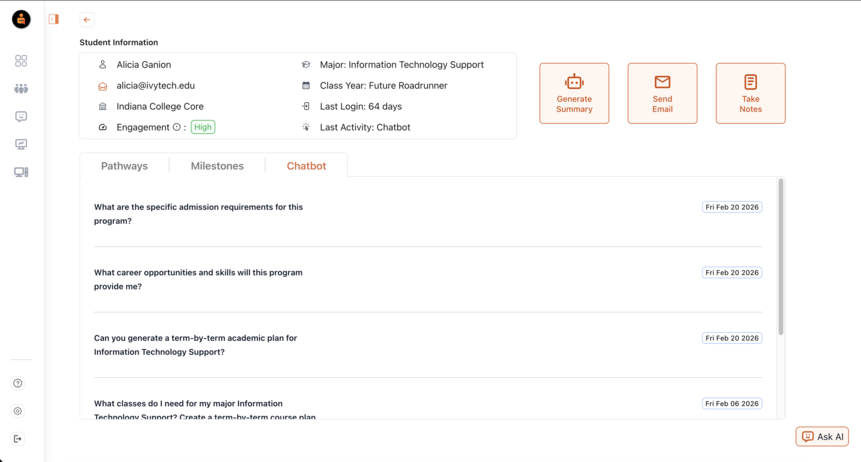
For colleges managing thousands of high school students across multiple partner schools, it is challenging to shift from being reactive to a more proactive, connected engagement model.
With the platform's case management capability, the team can now segment and track different dual enrollment populations while monitoring engagement and momentum over time. This gives staff a clearer picture of where a student is within the individual pathway, including early exploration, program consideration, advising activity, and next-step planning. It also helps create stronger handoffs by giving the appropriate staff and partners more useful context when responsibility for supporting a student moves from one team or stage to another.
Criteria met: Informed Advisors, Life Balance Guidance
4. Engagement Insights: Tracking Early Indicators for Student Success
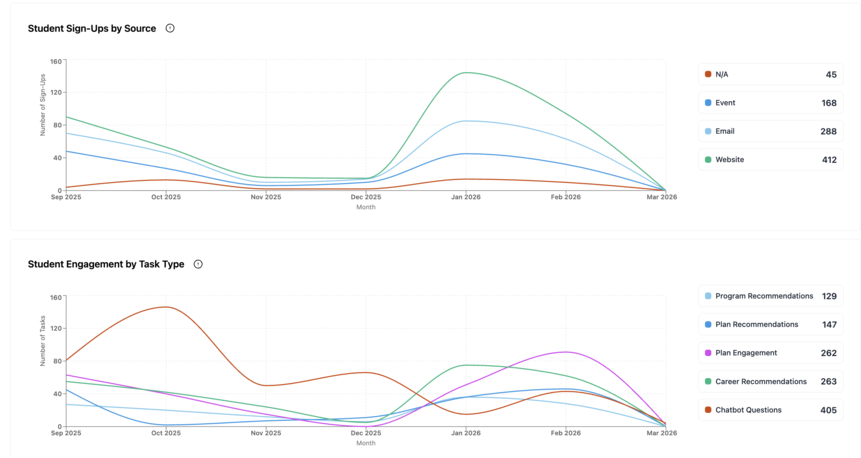
Dual enrollment students who disengage rarely announce it. They stop exploring resources, miss an advising appointment, or become unsure about what to do next. Without a connected view, those signals can be missed because no single advisor or partner has the time or context to track every student across systems and transition points. Engagement insights help surface patterns earlier so staff can respond with timely outreach, informed conversation, and coordinated support. The platform does not replace the relationship. It helps the people responsible for the relationship see where attention may be needed.
Criteria met: Early Awareness, Informed Advisors, Life Balance Guidance
"I shared the demo with one of our campus partners, and I thought I was going to have to reach across the table and pick his jaw back up, because he was just amazed by it. It was one of those things where he was just like, 'I didn’t know it could be this specific, and this specialized, and not just another chatbot.'" — Emery Peck
Summary
Effective dual enrollment models connect technology to a human-centered partnership structure in which high schools, advisors, career services professionals, students, and families share clearer information and stronger handoffs. For Ivy Tech CC Muncie, the value of responsible AI is not limited to answering questions. It is the ability to help organize the space between early interest, program selection, advising, and career exploration so that students can move through every decision with greater confidence and ease, and teams can support them at every step.