.jpg?width=150&height=75&name=Logo-Black%20(1).jpg)

San Francisco, CA — Advisor AI today announced the release of three integrated Pathways solutions...
Students want clarity and direction in their academic journeys. Research shows that a lack of structured guidance—not a lack of options—is a key reason students struggle to make progress (Bailey, Jaggars, & Jenkins, 2015). Surveys confirm that students across community colleges, HBCUs, and other institutions report a strong need for better planning tools and clearer academic pathways (Inside Higher Ed & Generation Lab, 2024).
Structured pathways across K–12, higher education, and career contexts improve credential attainment, advising, and career-connected learning, especially in environments where high student-to-counselor ratios limit personalized support (Gates Foundation).
Advisor AI Edition 2 addresses this gap, giving advisors and administrators the tools to turn student aspirations into actionable, personalized pathways, scale evidence-based guidance, and transform student outcomes.
1. Personalized, Structured Plan Generation
Advisor AI Edition 2 transforms career and academic interests into structured, multi-year plans aligned to courses, experiences, and key milestones, all in minutes. Students receive a clear roadmap for their academic journey, including suggested experiences, courses, and goals tailored to their chosen pathways.
"The platform helped me explore multiple interests at once. I’m passionate about both business and science, and for the first time, I could see what careers look like when those fields intersect. It gave me a clear picture of the possibilities, helped me prioritize my goals, and made me excited about planning my next steps."
— Alicia, Undergraduate Student
2. Customizable Milestones & Progress Tracking
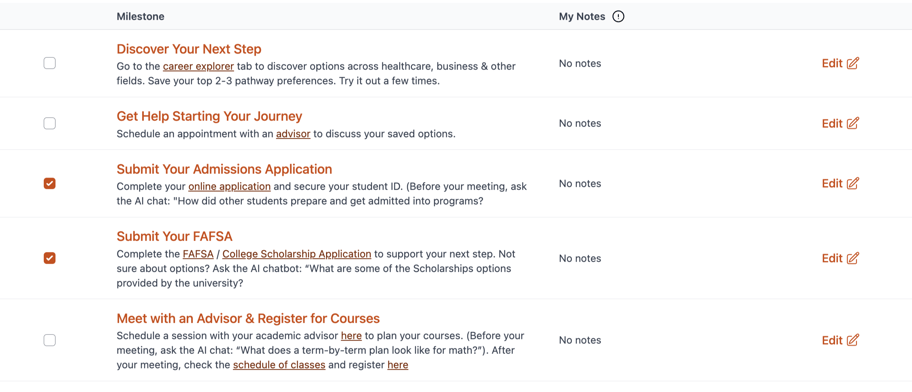
Students can visualize their progress through intuitive dashboards, track completion of milestones, and set new academic or career goals. Advisors can monitor engagement and identify intervention points in real time, ensuring that guidance is proactive and timely.
"There are so many great features of Advisor AI. Students can get answers instantly from the interactive advising assistant, saving time for them and the advisors. It's intuitive, fun, and easy to use for students and requires little training for advisors. But my favorite feature is that it incorporates career exploration and readiness, helping the student, advisor, and career services team make sure milestones are being accomplished in a timely manner."
— Alan Beaudrie, Academic Advisor with 20+ years of advising experiences
3. Streamlined Collaboration & Advisor Feedback
Advisor AI Edition 2 enables seamless sharing of plans and goals across advising teams. Advisors can provide timely, comprehensive feedback, leave notes, and collaborate on student pathways directly in the platform, making the advising process more coordinated and evidence based.
"What has excited me most about Artificial Intelligence is the promise and possibility that it has to free up time for advisors to focus their time and attention on building relationships rather than completing low impact tasks."
— Dr. Jennifer L. Bloom, Co-founder of Appreciative Advising and Appreciative Education
.png?width=850&height=454&name=image%20(5).png)
Appendix: Foundations for Student Success & Advising Excellence
After interviewing and running experiments with advising and workforce teams nationwide, our team at Advisor AI has compiled this repository of the most relevant research on student success. The insights presented are grounded in a wide body of external research and institutional practice. The sources below draw on peer-reviewed studies, national surveys, philanthropic initiatives, and documented case studies from higher education institutions and workforce organizations. We gratefully acknowledge the researchers, associations, and institutions whose work continues to inform and advance evidence-based approaches to student success and excellence in higher education.
Inside Higher Ed & Generation Lab. (2024, July 26). Survey: Students want more clarity
- Key Insight: Students want clarity about academic pathways and better planning tools.
- Methodology: Web-based survey conducted May 6–21, 2024. Sample drawn from Generation Lab’s student panel, which includes students from community colleges, HBCUs, women-only colleges, and other institution types. Panel recruited to approximate a probability-based sample through randomized college lists, proprietary contact methods, advertisement-based outreach, and geographic quotas. Sample included 5,025 students.
Bailey, T. R., Jaggars, S. S., & Jenkins, D. (2015). Redesigning America's community colleges: A clearer path to student success. Harvard University Press.
- Key Insight: Students don’t fail from a lack of options. They fail from a lack of direction. Structured guidance, real-time personalized advising, and clear program pathways improve student outcomes; over 400 colleges have adopted this model since publication.
- Methodology: Research synthesis and policy analysis drawing on 8+ years of research from the Community College Research Center (CCRC) at Teachers College, Columbia University, including studies on developmental education, student supports, program structure, and completion patterns across U.S. community colleges.
Gates Foundation. (n.d.). Pathways Gates Foundation.
- Key Insight: Structured pathways across K-12, higher education, and employers improve credential attainment, advising, and career-connected learning. High student-to-counselor ratios (385:1 vs. recommended 250:1) create gaps that AI and integrated supports can help address.
- Methodology: Philanthropic strategy framework and funding initiative based on multi-year research. Supported the AACC Pathways Project (300+ colleges), CCRC guided pathways research, and state-level initiatives for dual enrollment, mentoring, and advising interventions.
Community College Research Center (CCRC). (2015–present). CCRC Guided Pathways
- Key Insight: Whole-college redesign through structured program maps, proactive advising, and early momentum metrics improves completion rates, especially for students of color and low-income students.
- Methodology: Ongoing multi-year research program studying adoption, implementation, costs, and outcomes at 100+ colleges across Ohio, Tennessee, and Washington. Builds on nearly 30 years of community college research and informs the guided pathways model now used by 400+ colleges and 18 state systems.
Critelli, J. E., Propst Cuevas, A. E., & Bloom, J. L. (2022). Development of the Appreciative Advising Success Inventory (AASI). Journal of Appreciative Education.
- Key Insight: The Appreciative Advising Success Inventory (AASI) was developed and validated to measure how use of the Appreciative Advising framework by advisors correlates with student psychosocial factors (e.g., academic confidence, motivation, and intent to persist), showing that effective application of the framework positively influences predictors of student success.
- Methodology: Peer‑reviewed instrument development study using psychometric theory to create and validate the AASI, linking advisor practices grounded in Appreciative Advising with student success outcomes.

.png?height=200&name=We%E2%80%99re%20Attending%20CCCAOE%20(5).png)