.jpg?width=150&height=75&name=Logo-Black%20(1).jpg)

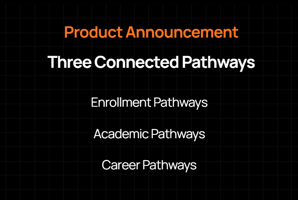
San Francisco, CA — Advisor AI today announced the release of three integrated Pathways solutions...
Research shows that career-connected learning directly influence student outcomes. High school and college students who engage in career exploration report stronger hope, ambition, and clarity about their educational paths (Inside Higher Ed, 2024; Gallup & New Hampshire Learning Initiative).
Yet many students remain uncertain: 66% don’t know exactly what career they want, and 74% say more access to career and education information would broaden their options (Jobs for the Future & Morning Consult, 2024).
Advisor AI Edition 1 helps advisors bridge this gap, making career and major exploration intuitive, actionable, and aligned with real-world labor market data. By scaling evidence-based guidance, institutions can enhance student engagement, improve career preparedness, and positively impact student lives.
1. Adaptive Career Interest Assessment
Advisor AI Edition 1 empowers advisors to guide students toward meaningful career directions through adaptive, research-based assessments. The platform evaluates seven key dimensions that influence career decision-making: activity preferences, project role inclinations, impact motivation, environmental fit, task satisfaction, subject interest, and problem-solving approach.
The assessment dynamically adjusts question pathways in real time, analyzing student responses to connect them with the most relevant majors. This creates a highly personalized exploration experience for each student. Career suggestions are continuously updated with real-time labor market data, ensuring recommendations reflect the evolving job market and provide actionable guidance for both career and major planning.
“This was a wonderful program to use with my two College Freshmen classes in guiding them with a tool for early course selections and choice of major. Students were able to explore areas of concentration and potential majors and discuss results live with an advisor.”
— Douglas Turrell, Professor, College of Business, Kutztown University
2. Major To Career Mapping Recommendations
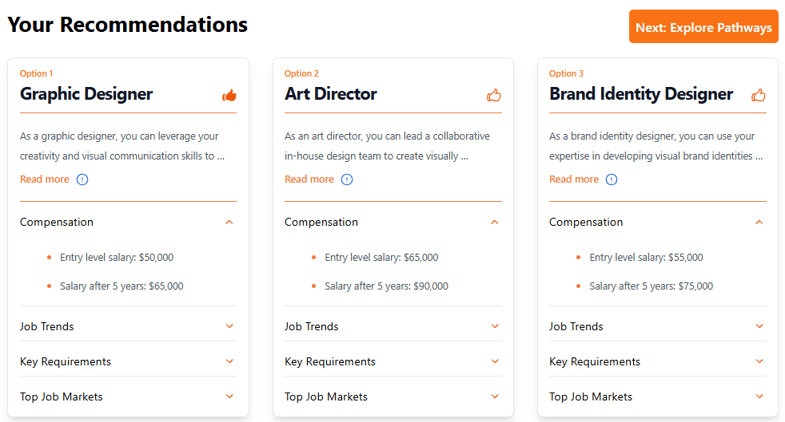
Students receive personalized major recommendations aligned with each institution’s programs and real-world labor market insights. Enabling advisors to easily share how different majors connect to in-demand opportunities.
“The platform was very simple to use. I found the salary and career growth information for my major very useful. It helped me realize that I am on the right trajectory.”
— Emily, Undergraduate Student
"I haven’t selected a major yet, so I feel lost when it comes to picking a program. I’ve mostly been asking friends for advice, but since we’re all in different fields, I’m not sure if I’m taking the right next step. Advisor AI helped me explore my options confidently. The system was very simple and easy to use."
— Joseph, Undergraduate Student
3. Student Report & Assessment Results
The platform makes it easy to track student engagement and major recommendations. Advisors can see assessment results, career preferences, and exploration patterns at a glance, enabling holistic, meaningful advising conversations.
"Advisor AI has significantly transformed the experience for both advisors and students. Its intuitive design and comprehensive features facilitate effortless tracking of student progress, leading to more efficient and meaningful interactions. This, in turn, enhances the advisor-student relationship."
— Dr. Soojin Kim, Professor & Department Chair, Kutztown University
Appendix: Foundations for Student Success & Advising Excellence
After interviewing and running experiments with advising and workforce teams nationwide, our team at Advisor AI has compiled this repository of the most relevant research on student success. The insights presented are grounded in a wide body of external research and institutional practice. The sources below draw on peer-reviewed studies, national surveys, philanthropic initiatives, and documented case studies from higher education institutions and workforce organizations. We gratefully acknowledge the researchers, associations, and institutions whose work continues to inform and advance evidence-based approaches to student success and excellence in higher education.
Kinzie, J., & Akyuz, F. (2022, May). Exploring the influence of course-based career experiences and faculty on students' career preparation. NACE Article.
- Key Insight: Course-based career experiences such as case studies, career research assignments, and learning from professionals strengthen students’ career preparation. Practical and applied majors like business and education provide more career-relevant experiences than arts, humanities, or sciences. Faculty interactions significantly influence students’ sense of career preparedness.
- Methodology: Peer-reviewed research using data from the Career & Workforce Preparation (CWP) module developed with Strada Education Network, analyzed seniors’ course experiences and career outcome perceptions.
Inside Higher Ed (2024), Gallup & New Hampshire Learning Initiative
- Key Insight: Career-connected learning experiences strengthen high school students’ sense of hope and postsecondary ambition; 38% of respondents reported that career learning directly informed their educational and career plans.
- Methodology: Web-based survey conducted May 1–June 7, 2024. Opt-in participation from schools and districts invited by the New Hampshire Learning Initiative. Sample included 8,634 high school students.
Gallup & Walton Family Foundation (2024), The 2024 Voices of Gen Z Study
- Key Insight: School engagement is strongly associated with students’ future outlook and overall life satisfaction, reinforcing the importance of meaningful connection during the educational experience.
- Methodology: Probability-based Gallup Panel™ web survey conducted April 26–May 9, 2024. Sample included 4,157 Gen Z respondents ages 12–27.
Jobs for the Future & Morning Consult. (2024). Career Navigation Survey.
- Key Insight: 66% of students don’t know exactly what career they want, and 74% say more access to career and education information would expand the options they see.
- Methodology: Online survey conducted May 2024. Quota sampling with strata defined by age, gender, educational attainment, and other demographics. Participants recruited through a diverse network of trusted survey panel providers. Sample included 2,046 young people aged 16–24 (Gen Z).

.png?height=200&name=We%E2%80%99re%20Attending%20CCCAOE%20(5).png)